
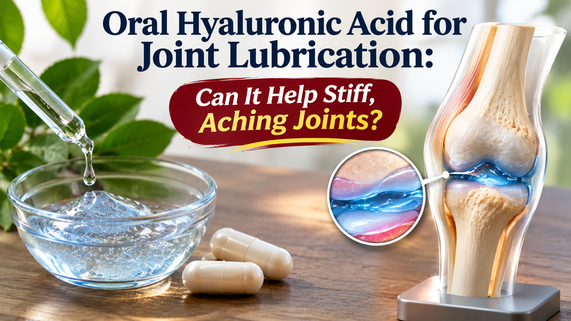
You stand up after sitting for an hour, and your knees feel unusually stiff. The first few steps are uncomfortable, but movement gradually becomes easier. It makes you wonder whether your joints are losing the natural cushioning that once helped them move smoothly.
This is one reason people are exploring oral hyaluronic acid for joint lubrication.
Hyaluronic acid is a natural component of the fluid surrounding movable joints. Because it helps this fluid absorb pressure and reduce friction, researchers have investigated whether taking it as a supplement could improve joint comfort.
But does swallowing hyaluronic acid actually help your knees? And how does it compare with exercise, physical therapy, or joint injections?
The research offers some encouraging findings, although important questions remain unanswered.
Why Do Joints Need Hyaluronic Acid?
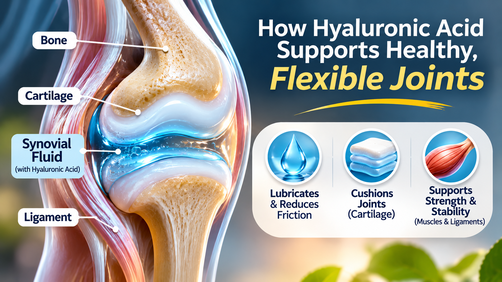
Inside your knees, hips, and other movable joints is a small amount of slippery liquid called synovial fluid.
This fluid helps joint surfaces glide against each other while distributing forces during movement.
Hyaluronic acid, also called hyaluronan, contributes to the fluid’s thickness and elastic properties. These characteristics help synovial fluid respond to different pressures as you walk, bend, or climb stairs.
Cartilage also plays an essential role. It covers the ends of bones and helps absorb impact.
Healthy joint movement therefore depends on several structures working together:
- Synovial fluid helps reduce friction.
- Cartilage cushions the joint surfaces.
- Muscles provide strength and stability.
- Ligaments support normal joint alignment.
In osteoarthritis, changes in cartilage, bone, inflammation, and surrounding tissues can contribute to discomfort and stiffness.
However, joint pain does not necessarily mean your knees have run out of lubrication. Muscle weakness, injury, tendon problems, and inflammatory conditions can cause similar symptoms.
Identifying the underlying cause is more useful than assuming every stiff joint needs a lubrication supplement.
How Does Oral Hyaluronic Acid Work After You Swallow It?
When hyaluronic acid is taken as a capsule, tablet, or liquid, it passes through the digestive system.
Researchers believe that some of the larger molecules may be broken into smaller fragments through digestive and microbial processes. These fragments may then be absorbed or interact with biological pathways.
Laboratory and animal studies have explored how oral hyaluronic acid might influence inflammatory responses and the body’s own hyaluronan metabolism.
But there is an important limitation.
Scientists have not established that swallowing a particular amount of hyaluronic acid directly increases the amount of synovial fluid inside human knees.
In other words, taking a capsule does not work like pouring additional fluid into a joint.
Any potential benefit may involve more complicated biological processes, and the exact mechanisms in humans remain uncertain.
Does Oral Hyaluronic Acid Actually Help Joint Stiffness and Pain?
This is where the research becomes interesting.
Several clinical trials have investigated whether oral hyaluronic acid supplements improve knee discomfort, stiffness, and everyday movement.
A systematic review published in the Mediterranean Journal of Rheumatology in 2024 examined 11 studies involving 597 participants.
Nine studies reported improvements in at least some outcomes, including pain, stiffness, or physical function.
That sounds promising, but the details matter.
Most studies were relatively small, treatment periods varied, and many products combined hyaluronic acid with other ingredients.
These differences make it difficult to determine how much improvement came specifically from hyaluronic acid.
What individual studies found
A 2012 randomized trial followed 60 people with knee osteoarthritis for 12 months.
Participants received either 200 mg of oral hyaluronic acid daily or a placebo. Both groups also performed quadriceps-strengthening exercises.
Symptoms improved in both groups, with a more favorable trend among participants taking hyaluronic acid, particularly those aged 70 or younger.
Because everyone exercised, the results also illustrate why a supplement should not be evaluated separately from other helpful treatments.
Another randomized study, published in 2023, investigated 111 mg of oral sodium hyaluronate daily for 12 weeks in adults with relatively healthy knees.
Researchers reported improvements in selected measures of knee discomfort.
A separate eight-week trial involving 47 people with mild knee osteoarthritis found improvements with a liquid supplement containing hyaluronic acid, glucosamine, and chondroitin.
However, because that product contained multiple active ingredients, the study cannot establish the independent effect of hyaluronic acid.
What the evidence means
The findings suggest that oral hyaluronic acid may improve symptoms for some people, particularly those experiencing knee discomfort.
They do not establish that every formulation works, that benefits are substantial for everyone, or that the supplement reverses osteoarthritis.
Larger, independent studies are still needed to identify which patients are most likely to benefit.
Can Oral Hyaluronic Acid Improve Knee Joint Lubrication?
Oral hyaluronic acid may help ease certain joint symptoms, but current human research does not conclusively show that supplements increase synovial fluid or restore natural joint lubrication.
Is Hyaluronic Acid Good for Joints? The answer depends on whether we are discussing its natural role in the body or the potential benefits of oral supplements.
Hyaluronic acid naturally helps lubricate joints, allowing smoother movement and reducing friction between joint surfaces. This function is well established.
However, taking hyaluronic acid orally does not necessarily mean it will replenish joint fluid or repair damaged cartilage. Clinical studies have not confirmed these effects.
Most research on oral supplementation focuses on improvements in joint pain, stiffness, and physical mobility rather than directly measuring changes in lubrication.
Although these improvements can be meaningful, they do not prove that synovial fluid levels have increased.
Someone may experience greater comfort during everyday activities without measurable changes in the fluid surrounding their knees.
For people considering joint lubrication supplements, the realistic expectation is potential relief from discomfort and stiffness, rather than guaranteed restoration of joint lubrication or damaged joint structures.
How Much Oral Hyaluronic Acid Is Used in Research?
There is no universally established therapeutic dose of oral hyaluronic acid for joint pain.
The 2024 systematic review identified daily doses ranging from approximately 30 mg to 300 mg across the included studies.
Here are several examples from published research.
| Research | Daily dose | Duration | Participants and findings |
|---|---|---|---|
| Tashiro et al., 2012 | 200 mg | 12 months | 60 people with knee osteoarthritis; improvements in both groups, with favorable trends for hyaluronic acid |
| Sugiyama et al., 2023 | 111 mg | 12 weeks | Adults with relatively healthy knees; improvements in selected discomfort outcomes |
| Eight-week combination trial, 2021 | Combination supplement; isolated HA dose not established here | 8 weeks | 47 people with mild knee osteoarthritis; improved symptoms, but the formula also contained glucosamine and chondroitin |
These studies differ in formulation, participants, and measured outcomes.
A larger dose does not necessarily produce better results, and a dose used in a clinical trial should not automatically be treated as a personal recommendation.
How Long Does Oral Hyaluronic Acid Take to Work?
Oral hyaluronic acid is not an immediate pain reliever.
Clinical trials have generally evaluated outcomes over several weeks or months.
Some studies have reported improvements after approximately eight to twelve weeks, while others followed participants for longer periods.
That does not mean everyone should expect noticeable results within that timeframe.
The cause of your discomfort, activity level, other treatments, and the particular supplement may all influence the outcome.
Instead of relying only on a pain score, pay attention to practical changes.
Are stairs becoming easier? Can you walk farther comfortably? Do your knees feel less stiff after sitting?
If symptoms worsen or interfere with everyday activities, seek medical advice rather than repeatedly increasing supplement doses.
Oral Hyaluronic Acid vs. Hyaluronic Acid Injections
Although both approaches involve hyaluronic acid, they are not interchangeable.
Oral supplements pass through the digestive system. Hyaluronic acid injections are administered directly into a joint by a healthcare professional.
The evidence and risks are also different.
| Feature | Oral hyaluronic acid | Hyaluronic acid injections |
|---|---|---|
| Administration | Swallowed as a supplement | Injected into the joint |
| Intended purpose | Potential symptom support | Attempted relief of osteoarthritis symptoms |
| Evidence | Limited but encouraging small trials | Extensively studied, with inconsistent clinically meaningful benefits |
| Risks | Possible digestive discomfort; limited long-term data | Injection discomfort, swelling, rare infection |
| Convenience | Can be taken at home | Requires clinical appointment |
| Cost | Depends on product and duration | Often more expensive; coverage varies |
Importantly, major clinical guidelines do not universally recommend hyaluronic acid injections.
The American Academy of Orthopaedic Surgeons advises against their routine use for symptomatic knee osteoarthritis. NICE also recommends against offering intra-articular hyaluronan injections for osteoarthritis.
These recommendations do not mean every patient has the same experience, but they show why stronger evidence is needed before describing injections as a reliable solution.
What Else Can Help Improve Joint Comfort and Mobility?
If your goal is to move more comfortably, supplements should not be the only strategy you consider.
Several approaches have stronger evidence for managing knee osteoarthritis.
Strengthen the muscles supporting your knees
The quadriceps at the front of your thighs help stabilize your knees during walking, standing, and stair climbing.
Hip muscles also contribute to balance and movement control.
A physical therapist can recommend exercises appropriate for your symptoms and fitness level.
Supported chair stands, gentle knee extensions, and carefully progressed strengthening exercises are common starting points.
Keep moving without overloading your joints
Low-impact activities such as walking, swimming, and stationary cycling can help maintain mobility.
Start at a manageable level and increase gradually.
Complete inactivity may make stiffness and muscle weakness worse, while excessive activity during a flare-up can aggravate symptoms.
Finding a sustainable balance is more useful than pushing through significant pain.
Consider weight management when relevant
For people with knee osteoarthritis who are overweight, gradual weight reduction can reduce mechanical stress and improve symptoms.
The American College of Rheumatology strongly recommends weight loss when appropriate, alongside exercise and other individualized treatments.
This is not about reaching a particular appearance or body size. It is about reducing unnecessary joint loading and improving daily function.
Use established treatments when needed
Depending on the diagnosis, topical anti-inflammatory medicines may help.
Physical therapy, activity modification, and certain braces can also be appropriate.
Sudden severe swelling, fever, an inability to bear weight, or a hot, red joint warrants prompt medical evaluation.
Are Oral Hyaluronic Acid Supplements Safe?
Oral hyaluronic acid has generally been well tolerated in the relatively small clinical studies conducted so far.
Reported adverse effects have usually been uncommon or mild.
However, the available research does not establish comprehensive long-term safety for every formulation.
Products may also contain additional ingredients, including herbs, collagen, glucosamine, or other compounds with their own precautions.
Before taking a supplement, check the label carefully if you:
- Are pregnant or breastfeeding.
- Take prescription medications.
- Have a chronic medical condition.
- Have allergies to animal-derived ingredients.
- Plan to combine several joint supplements.
An ingredient being naturally present in the human body does not guarantee that every concentrated supplement is appropriate for everyone.
What Should You Look for in a Hyaluronic Acid Joint Supplement?
Choosing a supplement involves more than comparing attractive packaging or the number of ingredients.
Start by checking the actual amount of hyaluronic acid per serving.
Some products contain pure sodium hyaluronate, while others use branded ingredient complexes that contain hyaluronic acid alongside other substances.
These amounts are not always directly comparable.
Also examine the source of the ingredient. Hyaluronic acid can be produced through microbial fermentation or obtained from animal-derived materials.
Look for clear manufacturing information, independent quality testing where available, and realistic claims.
A product promising to regenerate cartilage or eliminate arthritis pain should raise questions.
Finally, compare the cost per daily serving. An expensive multi-ingredient formula is not automatically more effective than a simpler product.
Where Does Joint Genesis Fit Into the Discussion?
Joint Genesis is one example of a supplement marketed for joint comfort that includes a hyaluronic acid-related ingredient.
Its central component is Mobilee®, a branded matrix containing hyaluronic acid along with other constituents, including collagen-related material.
The formulation is intended to support comfortable movement and joint wellness.
However, the quantity of a Mobilee® matrix should not be mistaken for the same quantity of pure hyaluronic acid.
Research involving Mobilee® or individual ingredients also cannot automatically establish that the complete Joint Genesis formula improves joint lubrication or treats osteoarthritis.
Anyone considering the product should check the current Supplement Facts label, ingredient sources, and safety information before purchasing.
For a closer look at its formulation and research, read our detailed Joint Genesis review on SupplementsSaver.
Recommended Joint Support Solutions
Explore top-rated supplemental formulas designed to support joint comfort and mobility side by side.


Is Oral Hyaluronic Acid Worth Trying for Joint Lubrication?
Oral hyaluronic acid may be worth discussing with a healthcare professional if you have persistent mild joint discomfort and are interested in supplements as an additional option.
Some clinical studies suggest improvements in knee symptoms, but the evidence remains too limited to promise consistent results.
It is especially important to recognize that joint pain can arise from several different conditions.
If your symptoms are caused by an injury, inflammatory arthritis, or another medical problem, a supplement may not address the underlying issue.
For many people with knee osteoarthritis, strengthening exercises, suitable physical activity, and established treatments offer a more dependable starting point.
The most useful approach is to understand your symptoms, choose treatments supported by evidence, and assess progress based on everyday function.
Frequently Asked Questions
Does oral hyaluronic acid really lubricate joints?
Hyaluronic acid naturally helps synovial fluid lubricate joints. However, oral supplementation has not been conclusively shown to increase joint-fluid lubrication in humans.
Can hyaluronic acid supplements help knee osteoarthritis?
Some small clinical trials have reported improvements in pain, stiffness, or function. Larger studies are needed before oral hyaluronic acid can be considered an established osteoarthritis treatment.
Is oral hyaluronic acid better than collagen for joints?
There is insufficient reliable head-to-head evidence to conclude that one is consistently better. They are different ingredients with different research backgrounds.
How long should you take hyaluronic acid before evaluating results?
Many studies assessed outcomes after approximately eight to twelve weeks. This provides research context, not a guaranteed timeframe or recommended treatment duration.
Can you take hyaluronic acid with glucosamine?
Some research has investigated combination products, but that does not establish safety or effectiveness for every person. Check other ingredients and medication interactions with a healthcare professional.
Does hyaluronic acid rebuild damaged cartilage?
There is no convincing clinical evidence that oral hyaluronic acid supplements rebuild damaged cartilage or reverse osteoarthritis.
Final Thoughts: Can Oral Hyaluronic Acid Support Better Joint Movement?
Research into oral hyaluronic acid for joint lubrication offers some encouraging possibilities, especially for people experiencing knee discomfort and stiffness.
Several clinical trials have reported symptom improvements, but the evidence does not establish that swallowing hyaluronic acid directly replenishes joint fluid or repairs cartilage.
For anyone considering a supplement, the most sensible approach is to check the formulation, understand the research limitations, and maintain realistic expectations.
Regular movement, appropriate strengthening, and treatment of the underlying cause remain essential for long-term joint health.
A supplement may be an additional consideration, but it should not replace approaches that are already supported by stronger clinical evidence.
Research References
- de Carvalho JF, Davidson J. Oral Hyaluronic Acid in Osteoarthritis and Low Back Pain: A Systematic Review. Mediterranean Journal of Rheumatology, 2024.
- Tashiro T, et al. Oral administration of polymer hyaluronic acid alleviates symptoms of knee osteoarthritis. The Scientific World Journal, 2012.
- Sugiyama K, et al. Oral sodium hyaluronate relieves knee discomfort. Experimental and Therapeutic Medicine, 2023.
- The effect of oral low molecular weight liquid Hyaluronic acid combination trial with glucosamine and chondroitin on knee osteoarthritis. Randomized clinical trial, 2021.
- American College of Rheumatology/Arthritis Foundation Guideline for Osteoarthritis Management.
- AAOS Clinical Practice Guideline: Management of Osteoarthritis of the Knee.
- NICE Guideline NG226: Osteoarthritis in Over 16s.