

FemiCore Daily Wellness Support for Bladder Balance & Feminine Comfort
FemiCore is a nutritional supplement designed to support everyday bladder comfort, urinary wellness, feminine balance, and a healthy microbiome. Its formula combines botanical ingredients, including cranberry extract and bearberry, with five Lactobacillus probiotic strains intended to complement a balanced lifestyle and provide convenient daily support for women who want to prioritize their urinary and intimate wellness.
But does FemiCore offer meaningful benefits, and is it worth adding to your daily routine? In this FemiCore Review, we examine what the supplement contains, how its ingredients are studied, its potential benefits, possible side effects, recommended use, pricing, and important limitations to consider before buying.
The goal is to help you understand what the formula may offer, what remains uncertain, and how to make an informed decision without relying solely on advertising claims.
Table of Contents
- • What Is FemiCore?
- • How Does Femicore Work?
- • FemiCore Ingredients Explained
- • Potential Benefits of FemiCore
- • Why Consider FemiCore?
- • How to Take FemiCore
- • FemiCore Side Effects and Safety
- • Who May Consider FemiCore?
- • FemiCore Pros and Cons
- • Price and Money-Back Guarantee
- • Frequently Asked Questions
- • Final Verdict
Quick verdict
FemiCore features an interesting combination of urinary-focused botanicals and probiotics, but its marketing claims should not be confused with proven treatments for infections. Verify label transparency, ingredient quantities, and refund terms before purchasing.

What Is FemiCore?
FemiCore is a dietary supplement marketed toward women who want additional support for bladder function, urinary comfort, and feminine microbiome balance. Its formulation combines selected plant extracts with probiotic bacteria from the Lactobacillus group.
The product is intended for women interested in maintaining everyday urinary wellness, including those who experience occasional urinary discomfort or want to learn more about supporting their intimate health.
The formula is described as containing cranberry extract, bearberry, Mimosa pudica, berberine, and five Lactobacillus strains. These ingredients have different properties, and the amount of scientific research available for each varies considerably.
It is important to understand that FemiCore is a supplement, not a prescription medicine. The manufacturer’s claims about supporting bladder control or feminine balance should not be interpreted as proof that the product can treat urinary tract infections (UTIs), cure incontinence, or resolve persistent urinary symptoms.
For this reason, the most useful way to evaluate FemiCore is to examine its ingredients, the evidence behind them, and the transparency of its product information.

Ready to Try FemiCore?
Check availability and current promotional discounts directly through the official secure portal.
Visit Official FemiCore Website →How Does FemiCore Work?
FemiCore is promoted as a combination of botanical ingredients and probiotics that may help support urinary wellness and a balanced feminine microbiome.
To understand this approach, it helps to know what the microbiome is. The microbiome refers to the community of microorganisms living in a particular environment in the body. The vaginal microbiome, for example, often contains beneficial Lactobacillus bacteria that help maintain an environment associated with vaginal health.
Researchers are also studying the relationship between microbial communities and urinary tract health. However, the effects of probiotics depend on the specific bacterial strain, dose, route of administration, and intended outcome. A probiotic that has been studied in one setting cannot automatically be assumed to produce the same results when included in a different supplement.
FemiCore’s botanical ingredients follow a separate approach. Cranberry has been investigated for its potential role in reducing recurrent UTIs, while bearberry has a history of traditional use for urinary symptoms. Other ingredients, including berberine and Mimosa pudica, have different research backgrounds and less established relevance to women’s urinary wellness.
The important distinction is that a plausible mechanism does not prove that FemiCore itself works as advertised. Product-specific clinical studies would be needed to establish whether this particular combination produces meaningful improvements in bladder comfort, urinary symptoms, or microbiome balance.
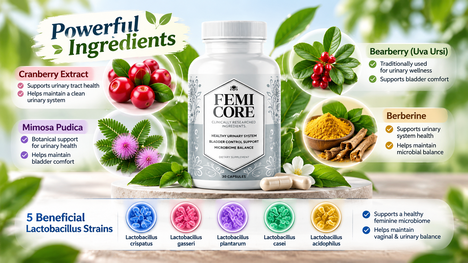
FemiCore Ingredients Explained
According to the manufacturer’s product descriptions, FemiCore contains four botanical ingredients or compounds and five Lactobacillus strains. The following analysis explains their general uses and research limitations.
The published descriptions reviewed for this article do not establish the exact amount of every ingredient or the colony-forming units (CFUs) of each probiotic strain. Without those details, it is difficult to assess the formula’s potency or compare it accurately with products that disclose their full composition.
1. Cranberry Extract
Cranberry is one of the better-studied ingredients associated with urinary tract wellness. It contains plant compounds called proanthocyanidins (PACs), which may help prevent certain bacteria from attaching to the urinary tract lining.
Research suggests that some cranberry products may reduce the risk of recurrent UTIs in women who have experienced them previously. However, results vary according to the product, formulation, and amount of relevant compounds.
The National Center for Complementary and Integrative Health (NCCIH) explains that cranberry products are not a treatment for an existing UTI. The evidence supporting prevention is also not universal across all populations and products.
Reference: NCCIH’s overview of cranberry.
For FemiCore, a key question is whether the cranberry extract provides a disclosed, meaningful amount of PACs. Without that information, the evidence for cranberry generally cannot establish the effectiveness of this particular formula.
2. Bearberry (Uva Ursi)
Bearberry is a botanical ingredient traditionally used in preparations intended for urinary complaints. It contains arbutin and other plant compounds that have attracted interest in research on urinary symptoms.
However, traditional use is not the same as proof of effectiveness, and findings from research on specific bearberry preparations cannot automatically be applied to FemiCore.
Bearberry also deserves particular attention from a safety perspective. Its suitability depends on the preparation, dose, duration of use, and an individual’s health circumstances. It should not be treated as a harmless everyday herb simply because it is plant-derived.
Anyone considering a supplement containing bearberry should check the product label and consult a healthcare professional, particularly when pregnant, breastfeeding, or managing an existing medical condition.
3. Mimosa Pudica
Mimosa pudica is a tropical plant used in traditional herbal practices. It is included in FemiCore’s advertised formula as part of its botanical blend.
Research into the plant has explored several biological properties, but evidence supporting its effectiveness for women’s urinary comfort or bladder control is limited.
There is insufficient evidence to conclude that Mimosa pudica in FemiCore improves bladder function, reduces urinary urgency, or prevents recurrent UTIs.
Consumers should therefore evaluate this ingredient cautiously rather than assuming that its traditional use guarantees a health benefit.
4. Berberine
Berberine is a plant-derived compound studied for several potential biological effects, including its role in metabolic health. It is also investigated for antimicrobial properties in laboratory and other research settings.
Nevertheless, evidence involving berberine in one health context does not establish that it improves urinary symptoms when taken as part of FemiCore.
Berberine may interact with medications, and it can cause digestive side effects. It is particularly unsuitable for self-directed use during pregnancy or breastfeeding because of safety concerns.
Women taking prescription medicines should consult a healthcare professional before using a supplement containing berberine.
5. Lactobacillus crispatus
Lactobacillus crispatus is associated with a healthy vaginal microbiome in many women. Certain preparations of this bacterium have been investigated for their potential role in maintaining vaginal microbial balance and reducing recurrent UTIs.
However, probiotic effects are strain-specific. Evidence from a particular strain or vaginal preparation cannot automatically be applied to an orally consumed product.
FemiCore’s published ingredient descriptions do not provide enough information to establish whether its specific strain and dose match those used in relevant studies.
6. Lactobacillus gasseri
Lactobacillus gasseri is another bacterial species found in some human microbial communities and studied for its probiotic properties.
Its potential relevance to feminine wellness makes it understandable why a manufacturer might include it in a women’s probiotic formula. However, evidence for a particular health outcome depends on the strain and formulation.
There is not enough information to conclude that the L. gasseri included in FemiCore independently improves bladder control or prevents UTIs.
7. Lactobacillus plantarum
Lactobacillus plantarum has been researched for its effects on microbial balance and other aspects of health. Certain strains have demonstrated promising properties in specific research settings.
However, its presence in a supplement does not establish that the finished product will improve urinary comfort or vaginal health. The strain identity, amount, stability, and formulation all matter when evaluating a probiotic.
8. Lactobacillus casei
Lactobacillus casei is a probiotic species studied for various potential health applications. Its effects depend on the specific strain and how it is used.
Research involving other probiotic preparations cannot be used as direct proof that this ingredient in FemiCore produces the same outcome.
Consumers should look for detailed strain identification and CFU information before drawing conclusions about a probiotic’s likely effectiveness.
9. Lactobacillus acidophilus
Lactobacillus acidophilus is a familiar probiotic species found in certain supplements and fermented products. Some strains have been studied for their role in maintaining microbial balance.
Nevertheless, the benefits of one L. acidophilus preparation may differ from those of another. The presence of this species alone does not demonstrate that FemiCore restores a healthy urinary microbiome or resolves intimate health concerns.
Ingredient Assessment
FemiCore combines ingredients with varying levels of scientific support. Cranberry has relevant evidence for reducing recurrent UTI risk in some women, but the product’s undisclosed ingredient quantities and strain details limit the conclusions that can be drawn about the complete formula.
Potential Benefits of FemiCore
FemiCore is marketed around urinary comfort, bladder support, and feminine microbiome balance. These are the main potential benefits to consider, while keeping the limitations of the evidence in mind.
Support for Everyday Urinary Wellness
The formula includes ingredients selected for their relevance to urinary health. Cranberry is the most recognizable example, although its research primarily concerns the risk of recurrent UTIs rather than general bladder control.
Whether FemiCore provides a meaningful benefit depends on its formulation and the individual using it.
Support for Feminine Microbiome Balance
The Lactobacillus strains are intended to support a balanced microbial environment. Maintaining a healthy vaginal microbiome is an important aspect of women’s health, but the effects of oral probiotics are not interchangeable with those of vaginal probiotic preparations.
There is insufficient product-specific evidence to confirm that FemiCore reliably improves feminine microbiome balance.
A Convenient Daily Routine
Combining several ingredients into one supplement may be convenient for people who prefer a simple routine. Convenience, however, should not be confused with effectiveness.
Additional Support Alongside Healthy Habits
Women may find it useful to review hydration, personal hygiene practices, and other everyday habits while addressing urinary wellness. Persistent symptoms should be assessed by a healthcare professional rather than managed through supplements alone.
Overall, these are potential areas of interest, not guaranteed outcomes. There is not enough verified clinical evidence to establish the size or consistency of benefits that users should expect from FemiCore.
Why Consider FemiCore?
There are several practical reasons a woman might investigate FemiCore before deciding whether it suits her needs.
First, it combines botanical ingredients and probiotics rather than relying on a single ingredient. This may appeal to consumers interested in a multi-ingredient approach to urinary wellness.
Second, a capsule-based product can be straightforward to incorporate into a routine when used according to the label.
However, several questions deserve attention before purchasing:
- Does the label disclose the amount of each ingredient?
- Are the probiotic strains identified precisely, and are their CFUs stated?
- Is there independent testing for identity, purity, and quality?
- Are there credible clinical trials involving the finished FemiCore product?
- Are the current price and refund conditions clearly explained?
These details matter because a long ingredient list does not necessarily make a supplement more effective. A transparent label and relevant clinical evidence are more useful indicators when comparing products.
FemiCore may be worth researching further, but the available product descriptions alone do not establish that it is more effective than alternatives.
How to Take FemiCore
The manufacturer’s FAQ recommends taking one capsule each morning with a large glass of water. Check the instructions on the packaging you receive to confirm that the recommendation remains current.
Do not exceed the stated serving in an attempt to obtain faster results. Taking more of a supplement does not necessarily improve its effects and may increase the risk of adverse reactions.
There is no well-established, independently verified timeline for when FemiCore should produce benefits. Individual experiences with supplements can vary, and the available information does not establish how quickly this particular product works.
If you experience recurring urinary symptoms, do not delay medical assessment while waiting for a supplement to take effect.
FemiCore Side Effects and Safety
FemiCore contains probiotics and botanical ingredients, so its safety depends on the specific formulation, dose, and user’s circumstances.
Possible considerations include:
- Digestive discomfort: Some probiotic supplements can cause gas, bloating, or other digestive symptoms.
- Medication interactions: Berberine may interact with prescription medicines. Cranberry also has a possible interaction with warfarin, although the evidence is conflicting.
- Bearberry-related concerns: Bearberry is not appropriate for every person, and its use requires attention to dose and duration.
- Pregnancy and breastfeeding: Do not assume that the complete formula is safe during pregnancy or breastfeeding. Obtain professional advice before use.
- Existing medical conditions: People with kidney or liver conditions, significant health concerns, or regular prescription medication use should consult a healthcare professional before starting the supplement.
The available marketing descriptions do not provide enough information to quantify the likelihood of side effects from FemiCore specifically.
Most importantly, FemiCore should not replace medical treatment for a suspected UTI. Burning during urination, blood in the urine, fever, back or flank pain, or worsening symptoms require prompt medical assessment. Fever with urinary symptoms or significant back or flank pain can indicate a more serious infection.
For further guidance, consult the NHS information on urinary tract infections.
Who May Consider FemiCore?
FemiCore may interest adult women who want to investigate supplements marketed for urinary wellness and feminine microbiome support.
It may also attract women who prefer a combination of botanical ingredients and probiotics in one product. However, those experiencing recurring urinary symptoms should seek medical advice to identify the cause and discuss appropriate prevention strategies.
FemiCore should not be used as a substitute for evaluation or treatment of urinary incontinence, recurrent infections, unexplained pain, or other persistent symptoms.
Pregnant or breastfeeding women and anyone taking medication should seek professional advice before considering this formula.
FemiCore Pros and Cons
Pros
- ✓ Combines botanical ingredients with five advertised Lactobacillus strains.
- ✓ Offers a capsule-based daily routine.
- ✓ Includes cranberry, an ingredient with relevant research on recurrent UTI prevention in some women.
- ✓ Targets a specific area of women’s wellness.
Cons
- ✕ The available information does not establish that FemiCore itself has been proven effective in clinical trials.
- ✕ Individual ingredient quantities and probiotic CFUs are not clearly established in the product descriptions reviewed.
- ✕ Bearberry and berberine raise important suitability and interaction considerations.
- ✕ Results cannot be guaranteed, and the formula should not be relied on to treat urinary infections or other medical conditions.
- ✕ Buyers need to verify the current price and refund conditions before ordering.
Price and Money-Back Guarantee
FemiCore’s official marketing pages have advertised promotional pricing of approximately $49 per bottle, with prices varying according to the offer and package selected. These offers may change, so the checkout page should be treated as the final source for the current price.
The manufacturer’s website also advertises a 60-day money-back guarantee. The precise return requirements may vary by sales page, so review the terms applicable to your order before buying. Check whether all bottles must be returned, whether shipping and handling charges are excluded, and how the refund request must be submitted.
A money-back guarantee can reduce some purchasing risk, but it does not demonstrate that the supplement is clinically effective.
Before placing an order, compare the total package price, shipping charges, return requirements, and the amount of product supplied. Avoid choosing a larger package solely because the advertised discount appears attractive.
Frequently Asked Questions
1. What is FemiCore used for?
FemiCore is a dietary supplement marketed to support everyday bladder comfort, urinary wellness, and feminine microbiome balance. It contains botanical ingredients and Lactobacillus probiotics. It is not a proven treatment for urinary tract infections or urinary incontinence.
2. How does FemiCore work?
The manufacturer describes a combination of plant extracts and probiotics intended to support urinary wellness and microbial balance. However, there is insufficient product-specific clinical evidence to confirm that the formula produces the advertised benefits.
3. What ingredients are in FemiCore?
The advertised formula includes cranberry extract, bearberry, Mimosa pudica, berberine, and five Lactobacillus strains: L. crispatus, L. gasseri, L. plantarum, L. casei, and L. acidophilus. Check the current packaging to confirm the complete ingredient list and quantities.
4. How should FemiCore be taken?
The manufacturer’s FAQ recommends one capsule each morning with a large glass of water. Follow the directions on your product packaging and consult a healthcare professional if you have questions about suitability.
5. How long does FemiCore take to work?
There is no independently established timeframe for FemiCore’s effects. The response to a supplement can vary, and there is insufficient evidence to promise noticeable improvements within a specific number of days or weeks.
6. Does FemiCore have any side effects?
Possible concerns include digestive discomfort, individual sensitivity, and interactions with medications. Berberine and bearberry require particular attention. Consult a healthcare professional before use if you take medication, have an existing medical condition, or are pregnant or breastfeeding.
7. Can FemiCore treat a urinary tract infection?
No. FemiCore should not be used as a substitute for diagnosing or treating a UTI. Cranberry products may help reduce recurrent UTI risk in some women, but that does not mean cranberry or FemiCore can treat an active infection.
8. Is FemiCore suitable for pregnant or breastfeeding women?
The available information does not establish that the complete formula is safe during pregnancy or breastfeeding. Because it contains berberine and bearberry, women in these circumstances should not use it without advice from a qualified healthcare professional.
9. Are there clinical studies proving FemiCore works?
The product descriptions reviewed for this article do not establish that the finished FemiCore formula has been proven effective in controlled clinical trials. Research on individual ingredients should not be treated as proof that the complete supplement produces the same outcomes.
10. Where can consumers check the price and refund policy?
Check the official FemiCore sales page and the terms displayed during checkout. Verify the final price, package size, shipping costs, return requirements, and any advertised 60-day money-back guarantee before ordering.
Final Verdict: Is FemiCore Worth Considering?
FemiCore takes a multi-ingredient approach to women’s urinary wellness by combining cranberry, bearberry, Mimosa pudica, berberine, and five Lactobacillus probiotic strains. The combination may appeal to women interested in exploring supplements that focus on urinary comfort and feminine microbiome balance.
However, the most important question is not how many ingredients the product contains. It is whether those ingredients are provided in appropriate amounts, whether the probiotic strains are adequately identified, and whether the finished formula has been shown to deliver meaningful results.
Cranberry has some supporting evidence for reducing recurrent UTIs in certain women, but its benefits depend on the preparation and do not extend to treating an existing infection. Evidence for other ingredients varies, and the available product descriptions do not establish that FemiCore itself reliably improves bladder control or urinary comfort.
Before purchasing, review the complete label, investigate the evidence behind the formula, check the current price, and read the refund conditions. If you take medication or have an existing medical condition, seek professional advice about potential interactions and suitability.
The bottom line: FemiCore may be worth researching as a women’s wellness supplement, but its advertised benefits should be viewed cautiously until stronger product-specific evidence and more detailed formulation information are available. For persistent urinary symptoms, a proper medical assessment is a more reliable first step than relying on a supplement.