
You have the time. You have the task. So why can’t you stay focused long enough to finish it?
You sit down, open your laptop, and tell yourself you’ll get it done quickly. Then a notification pops up. You check your phone. An email catches your attention. One unrelated tab becomes three. Before you know it, your original task is still sitting there—and your concentration has completely disappeared.
The problem may not be that you don’t want to focus. It may be that your brain is constantly being pulled in a dozen different directions.
And in a world built around notifications, social media, emails, meetings, and endless information, finding a simple way to settle your attention can be harder than it sounds.
This is exactly why simple, convenient tools designed to fit into everyday routines are becoming increasingly interesting.
BrainSong takes a different approach: instead of asking you to completely change your routine, it uses specially designed audio to create a listening experience intended to support focus and mental clarity.
But how does it actually work?
Can sound really influence the way your brain operates? And what makes BrainSong different from simply listening to ordinary music?
Let’s break it down.
What Is BrainSong?
BrainSong is a digital audio program designed around the concept of gamma-wave entrainment.
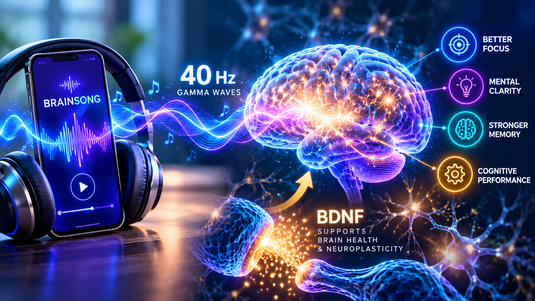
The program is promoted as a short listening experience, with its primary track presented as a 12-minute audio session. According to the product’s current information, the program uses gamma-frequency audio, particularly around the 40 Hz range, and is intended to support areas such as focus, memory and mental clarity.
There is no complicated equipment involved.
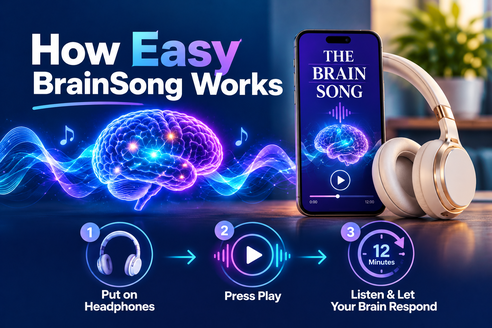
The basic process is straightforward:
Put on headphones → start the audio → listen for the recommended period.
That simplicity is an important part of the concept.
BrainSong is not trying to add another complicated task to your day. It is designed to become a small part of a routine you already have.
And that raises the more interesting question:
What is actually happening while you listen?
The Basic Idea Behind BrainSong
To understand BrainSong, you first need to understand something about the brain.
Your brain is constantly producing electrical activity. That activity occurs across different frequency ranges, and researchers often describe these patterns using terms such as delta, theta, alpha, beta and gamma.
Gamma activity is generally associated with higher-frequency brain activity and has been studied in connection with processes involving attention, perception and cognition.
BrainSong’s approach focuses on this gamma range.
The underlying concept is called brainwave entrainment.
In simple terms, entrainment refers to the possibility that rhythmic external stimulation can influence the timing or pattern of neural activity.
Think of it like a metronome.
If you hear a steady rhythm, your attention naturally becomes aware of that rhythm. The BrainSong concept takes this basic principle into the audio environment and uses carefully designed frequencies as the stimulus.
The goal is not to “force” the brain to do something.
Rather, the audio is designed to provide a consistent rhythmic signal that may interact with naturally occurring patterns of brain activity.
That is the foundation behind the BrainSong experience.
Why Does BrainSong Use Gamma Frequencies?
This is where the science becomes particularly interesting.
Gamma frequencies are among the faster patterns of neural oscillation studied in neuroscience.
Researchers have investigated gamma activity in relation to attention, sensory processing, learning and memory.
BrainSong’s promotional material places particular emphasis on the 40 Hz gamma range and connects it with cognitive performance and BDNF, or brain-derived neurotrophic factor.
BDNF is a naturally occurring protein involved in neuronal health, learning and neuroplasticity.
You may see it described online as a kind of “growth factor” for the brain because of its role in supporting neurons and connections between them.
However, there is an important distinction here.
Research into gamma activity and BDNF does not automatically mean that listening to BrainSong will produce a specific increase in BDNF or guarantee better memory.
The scientific concept is one thing.
The effect of a particular commercial audio product is another.
So the most sensible way to understand BrainSong is as an audio-based wellness approach inspired by research into brain activity, rather than as a proven medical treatment.
So, How Does BrainSong Work?
The process can be understood in three simple stages.
1. The Audio Provides a Repeating Stimulus
BrainSong uses carefully produced audio built around specific frequency patterns.
When you listen through headphones, your auditory system receives that repeating stimulus.
The purpose is to create a consistent rhythmic environment rather than ordinary background music.
2. Your Brain Processes the Sound
Your brain does not simply “hear” sound.
The auditory system continuously analyzes timing, rhythm, frequency and patterns.
Because the BrainSong audio is designed around specific rhythmic characteristics, the concept is that the brain may respond to those patterns through a process associated with neural entrainment.
This is the part that makes BrainSong different from simply playing relaxing music.
The audio is designed with a particular neurological concept in mind.
3. You Use the Session as a Focus Routine
This is the practical part.
Once the audio begins, there is nothing complicated to remember.
You listen.
The current BrainSong presentation describes a primary 12-minute track and additional shorter audio options intended for situations such as a quick focus reset or a calming session.
That makes the concept particularly easy to understand:
The technology is in the audio. Your job is simply to listen.
Why Would Someone Need Something This Simple?
Because attention has become expensive.
Not financially.
Mentally.
Think about a normal workday.
You receive a message.
Then an email.
Then another notification.
You switch applications.
Someone calls.
You return to your original task.
Then you realize you have been staring at the same paragraph for five minutes.
This constant switching can make focused work feel harder than it should.
And this is why people often look for “instant” solutions.
They don’t necessarily want magic.
They want less friction.
If something takes 12 minutes instead of requiring an hour-long routine, it is easier to try.
If it works with headphones instead of special equipment, it is easier to use.
If it can be placed before a study session, meeting or work block, it becomes easier to remember.
That convenience is a major part of BrainSong’s appeal.
BrainSong Is Not About Doing More
One interesting aspect of an audio-based approach is that it does not require more activity.
In fact, the idea is almost the opposite.
You stop.
You put on your headphones.
You listen.
For someone who spends most of the day moving between tasks, that short pause can itself become valuable.
Imagine starting your morning with your coffee and a short audio session before opening your inbox.
Or taking a brief break before an important meeting.
Or listening before sitting down to study.
The point is not that the audio magically solves every concentration problem.
The point is that it creates a deliberate transition into a focused period.
That can be useful because the brain often benefits from clear cues separating one activity from another.
What Might BrainSong Help With?
BrainSong is primarily presented around focus, memory and mental clarity.
People interested in the concept may be looking for support with everyday situations such as:
- Getting into a focused work session
- Preparing for mentally demanding tasks
- Reducing the feeling of scattered attention
- Creating a consistent concentration routine
- Supporting a calmer, more alert state
- Building a short mental reset into the day
But expectations matter.
BrainSong should not be viewed as something that replaces sleep, proper nutrition, physical activity or treatment for a medical condition.
If poor concentration or significant memory problems are persistent, the underlying cause deserves attention rather than simply adding another wellness product.
Why Short Sessions Can Be More Practical
A common problem with self-improvement routines is not necessarily that they are ineffective.
It is that people stop doing them.
A 60-minute routine sounds reasonable on paper.
Then Monday becomes busy.
Tuesday becomes stressful.
Wednesday you forget.
By Friday, the routine is gone.
A short audio session has a different advantage: low commitment.
You do not need to find a huge block of time.
You do not need to prepare a meal.
You do not need gym equipment.
You do not need to learn a complicated technique.
The current BrainSong program describes its main session as 12 minutes, making it possible to place the listening period around existing daily activities.
That is an important practical difference.
What Could a BrainSong Routine Look Like?
There is no need to make it complicated.
For example:
Morning
Wake up → coffee → BrainSong → begin work.
Or:
Before studying
Sit down → headphones on → BrainSong → begin the study session.
Or:
Before a demanding task
Finish routine work → short BrainSong session → start the important task.
The audio becomes a cue.
Instead of repeatedly telling yourself, “I need to focus now,” you create a consistent ritual that signals the beginning of focused work.
That may be one of the most practical reasons people find structured audio routines appealing.
What About the “Instant” Effect?
This deserves some clarification.
When people search for an instant focus solution, they usually do not want a complicated explanation.
They want something they can use now.
BrainSong fits that expectation in terms of accessibility.
The audio can be accessed digitally, and the listening process is short.
But accessibility should not be confused with guaranteed instant results.
Some listeners may notice a subjective difference quickly. Others may notice little or nothing.
Individual experiences can vary.
That is why the better question is not:
“Will BrainSong instantly transform my brain?”
A more useful question is:
“Can this short audio routine help me create a better environment for focused work?”
That is a much more realistic expectation.
Who Could Find This Approach Interesting?
BrainSong may appeal particularly to people who prefer simple, non-pill-based wellness tools.
For example:
Busy Professionals
Someone who spends the day jumping between emails, meetings and projects may appreciate a short transition before concentrated work.
Students
Students often need long periods of sustained attention, making a structured pre-study routine potentially useful.
Remote Workers
Working from home can blur the boundary between work and everything else. A consistent audio ritual may provide a simple signal that it is time to concentrate.
People Who Prefer Digital Wellness Tools
Not everyone wants supplements, complicated exercises or elaborate routines. Some people simply prefer putting on headphones and following an audio session.
The Bigger Idea Behind BrainSong
The interesting part of BrainSong is not simply the audio file.
It is the combination of neuroscience-inspired audio + convenience + routine.
Modern life creates an unusual problem.
We have access to more information than any previous generation, but our attention is constantly being divided.
At the same time, many people are looking for ways to improve productivity without adding another exhausting responsibility to their schedule.
A short audio routine attempts to meet that demand from a different direction.
Instead of asking:
“What else can I add to my day?”
the approach asks:
“Can I use a few minutes more intentionally?”
That is a much easier proposition for many busy people.
Final Thoughts: Is BrainSong About the Audio or the Routine?
BrainSong is built around an interesting idea: use specifically designed audio to create a short, repeatable listening experience centered around gamma-frequency stimulation and the concept of brainwave entrainment.
The science behind brainwave activity and gamma frequencies is an active area of research, while claims about the specific effects of a commercial BrainSong session should be considered separately from broader neuroscience research.
That distinction does not make the concept uninteresting.
Quite the opposite.
It gives you a clearer picture of what BrainSong actually is.
It is a simple digital audio approach that can potentially become part of a focused daily routine.
No complicated preparation.
No lengthy protocol.
Just a short period of intentional listening.
And perhaps that is why solutions like brainsong attract attention in the first place.
People are not necessarily looking for another complicated project.
They are looking for something they can actually fit into their lives.